
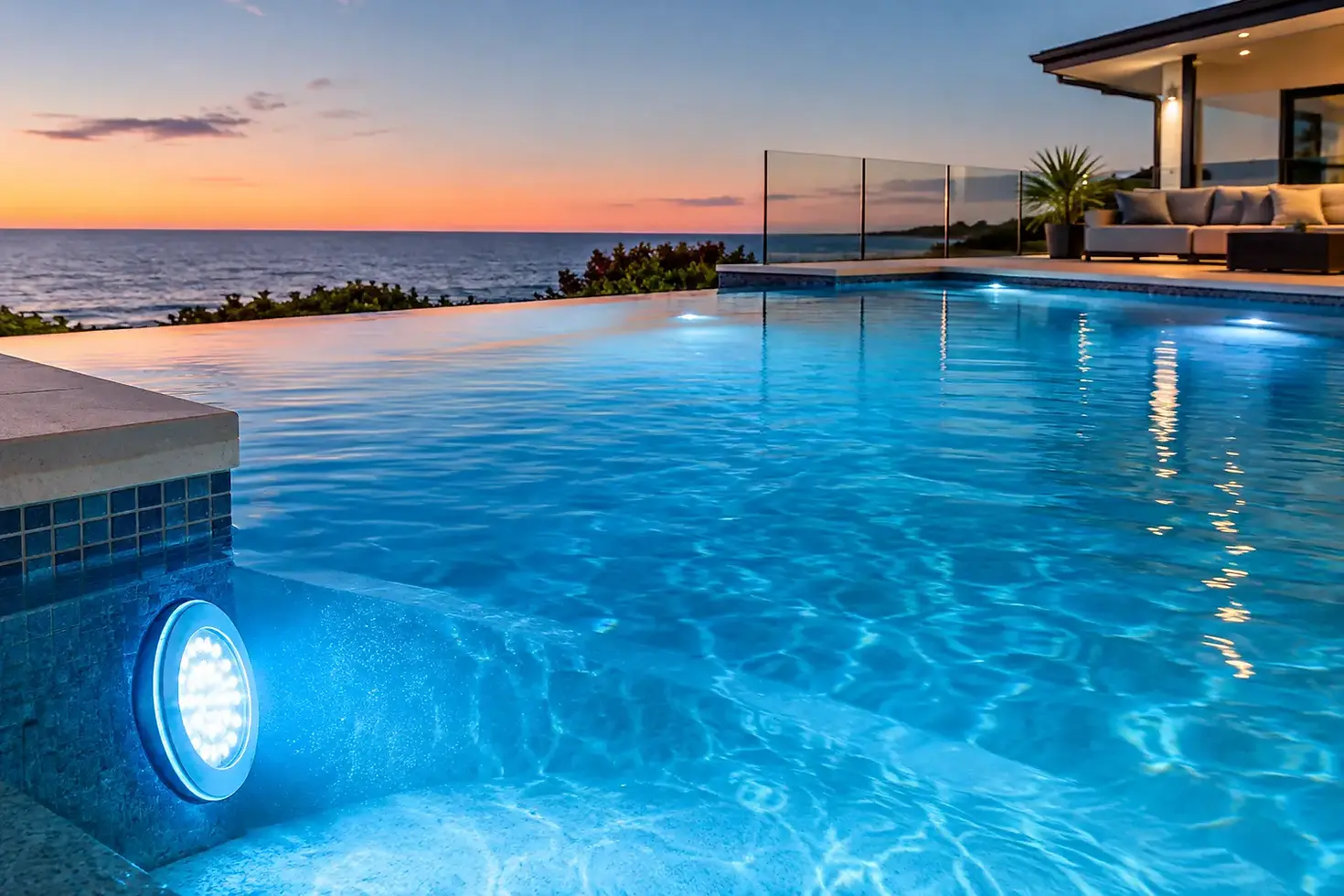
Best Pool Lights for Saltwater Pools in Australia

A salt chlorinated pool should look inviting after sunset, not expose weak points in a lighting installation. Searches for “best pool lights saltwater pools” are really asking a more useful question: which underwater lights will retain their appearance, seal integrity and lighting quality around chlorinated salt water over time?
For Australian pool owners and trade professionals, the answer is rarely a single product type. The right choice depends on the pool finish, existing niches or fittings, desired light effect, electrical design and how accessible the fittings will be for future service. Start with submerged-duty construction, then select the output and colour capability that suits the project.
What saltwater pools demand from underwater lights
A saltwater pool is not the same environment as the open ocean, but it is still demanding. Salt chlorination systems typically operate at a much lower salt concentration than seawater, yet dissolved salt, sanitiser, water balance and constant wet-dry exposure at the waterline can all contribute to corrosion and material fatigue.
The issue is not simply whether a fitting is labelled stainless steel or waterproof. Low-grade metal trim can stain or pit, fasteners may deteriorate, and a poorly designed seal can allow moisture into the light body. Once water reaches the electronics, even a visually minor failure can mean replacing the entire unit.
A premium pool light should therefore be assessed as a complete submerged assembly: housing, lens, cable entry, seals, fasteners, driver compatibility and thermal management. A high ingress-protection rating is a valuable quality marker, but it should sit alongside materials designed for ongoing pool immersion and a correctly specified installation.
Best pool lights for saltwater pools: the essential criteria
The best pool lights for saltwater pools combine a sealed, pool-suitable body with lighting performance that matches the pool rather than merely producing the highest possible output. Four selection areas deserve particular attention.
Construction and sealing: Look for a purpose-built underwater fitting with a durable lens, corrosion-conscious housing and dependable cable sealing. IP68 indicates suitability for continuous immersion when used within the manufacturer’s stated conditions. IP69 offers further protection against high-pressure water ingress, but neither rating removes the need to check the full product specification.
Mounting format: A flush-mounted light creates a refined, integrated finish and is often selected for new builds or major renovations. Surface or niche-compatible formats can simplify retrofit work, particularly where the shell and existing conduit limit changes. The best mounting style is the one that fits securely without creating unnecessary work behind the pool wall.
Light output and beam spread: More lumens do not automatically make a pool look better. A narrow, intense beam can create bright hotspots, while a wider beam may give a more even wash across a pale interior. Pool size, depth, shape and finish all influence how many fittings are required and where they should sit.
White or RGB capability: Crisp white light is practical, elegant and easy to live with. RGB lighting gives owners the freedom to create atmosphere for entertaining, landscaping and special occasions. For a premium result, colour should be even and controlled, not patchy or overly saturated.
Materials matter more than a polished finish
A polished metal face can look convincing at handover, but long-term saltwater performance comes from the materials beneath the surface. Ask what the lens is made from, how the cable enters the body, whether the fasteners are suitable for the environment and whether the light has been engineered for submerged operation rather than adapted from a general outdoor fitting.
Composite housings and high-quality polymers can be excellent choices because they do not rely on a decorative metal finish to resist corrosion. Where metal components are used, their grade, isolation from dissimilar metals and exposure to treated water should be considered carefully. This is especially relevant around screws, retaining rings and fittings near the waterline.
For pool builders, consistency is also valuable. Specifying a proven light family across projects makes mounting, transformer selection and client handover more predictable. For homeowners, it reduces the risk of mixing components that appear compatible but perform differently once installed.
Choose output for the pool finish and layout
Lighting behaves differently in every pool. White, light-blue and pale aggregate interiors reflect more light, so they can often achieve a premium evening effect with moderate output. Dark tiles, black interiors and deep pools absorb more light and generally require more careful placement or additional fittings to avoid a flat, underlit appearance.
A rectangular lap pool may be lit effectively from one long wall, depending on its dimensions and the beam pattern. A freeform pool, stepped entry or pool with benches often benefits from multiple lighting points so corners and changes in level do not disappear after dark. Avoid placing lights where they will shine directly into the main seating area or across the line of sight from the house.
For renovation projects, match new lighting to the pool’s practical constraints before falling in love with a specification. Existing conduits, niche size, cable runs and equipment-pad capacity can influence the most sensible upgrade path. A capable installer can confirm whether a straightforward retrofit is appropriate or whether the project calls for new fittings and cabling.
White light versus RGB for a premium result
White LEDs remain the preferred choice for many architectural pools. They reveal water clarity, make steps easier to see and complement most exterior lighting schemes. The colour temperature matters: a cooler white can feel clean and contemporary, while a warmer white may suit timber, stone and softer landscape lighting.
RGB lighting offers a different kind of value. It can shift a pool from a calm blue evening setting to a vivid entertaining feature without changing the hardware. It is particularly effective where the pool is visible from indoor living areas, an alfresco space or a waterfront entertaining deck.
There is a trade-off. RGB systems require compatible control equipment and thoughtful commissioning to deliver reliable colour selection and synchronisation. If the pool will be used mainly for laps, supervision or everyday family time, quality white light may be the more direct choice. If visual impact is central to the brief, RGB can justify the added system complexity.
Do not treat the IP rating as the whole specification
IP ratings are worth understanding because they describe protection against ingress. IP68 is commonly associated with equipment designed for continuous submersion, while IP69 addresses resistance to powerful, high-temperature water jets under defined test conditions. These ratings are meaningful indicators of engineered protection, particularly for underwater lighting.
However, an IP rating alone cannot tell you whether a light suits a salt chlorinated pool, how deep it may be installed, whether its cable and transformer are compatible, or how it will be serviced years later. Always assess the manufacturer’s stated application, electrical requirements and installation instructions as a complete set.
This is where Japanese-made underwater lighting can offer confidence. AquaIDEA products are designed around high-specification submerged performance, including IP68-IP69 protection across selected ranges, with configurations suited to sophisticated pool and marine lighting projects. The same discipline that matters below a vessel’s waterline is valuable in a premium pool installation.
Installation determines the life of the light
Even the best light can be compromised by poor installation. Underwater electrical work should be planned and completed by qualified professionals in line with applicable Australian requirements, product instructions and the pool’s overall electrical design. This includes using the correct low-voltage supply, suitable cable routing and accessible equipment where possible.
Do not assume an existing transformer is appropriate for a new LED fitting. Voltage, wattage, driver type, control method and total load must all align. In RGB projects, confirm how the lights will be controlled before walls are closed or paving is completed. A well-planned system is easier to operate and far less frustrating to diagnose later.
Service access deserves the same attention. Lamps and integrated LED fittings have long service lives, but no underwater component should be treated as impossible to replace. Leave practical access to junction points, control equipment and any equipment that may need inspection. For builders, this protects the project. For owners, it protects the investment.
A smarter way to compare pool lights
When comparing options, ask suppliers and installers for more than a wattage figure and a photo. Confirm the intended water environment, mounting arrangement, ingress rating, beam characteristics, cable length, operating voltage, control compatibility and warranty support. If the pool uses salt chlorination, state that clearly at the specification stage.
It also pays to consider the finished scene rather than the light in isolation. The strongest result combines underwater illumination with considered garden, path and architectural lighting. Pool lights should make the water look dimensional and inviting, while preserving comfortable visibility around steps, edges and entertaining areas.
Choose fittings built for the environment, specify them around the pool’s actual geometry and insist on a professional electrical installation. That approach delivers the quiet confidence premium pool lighting should provide: clear water, controlled colour and a finish that continues to look considered long after the first evening swim.


Comments