

How to Choose Transom Lights for Your Boat

A transom light is easy to notice when it is working well and hard to ignore when it is not. The right installation gives a boat a clean, premium waterline glow, improves night-time presence at anchor and brings the stern to life without distracting from the vessel itself. Knowing how to choose transom lights starts with more than selecting a colour. Hull construction, mounting method, electrical capacity and the conditions your boat faces all determine whether the result looks refined and performs reliably.
For Australian boat owners, that decision needs to account for saltwater, heat, UV exposure and regular washdowns. For builders and installers, it must also suit the vessel layout, build schedule and expected service life. A well-specified underwater light is an engineered component, not simply an accessory.
How to choose transom lights for the right fitment
The first decision is whether a transom-mounted light is suitable for the boat. These lights are fixed externally to the transom, with the body sitting on the hull surface and the cable passing through a sealed penetration. They are a practical option for many retrofits because they generally require a smaller hull opening than flush-mounted fittings.
Transom-mounted lights suit planing boats, sports cruisers, tenders and many yachts where access inside the stern is available. They can also make future servicing more straightforward, since the light remains accessible from outside the hull. The trade-off is visual profile. A surface-mounted unit is visible above the waterline when the boat is out of the water, so its housing design and finish should complement the vessel.
Before choosing a model, inspect the available flat area on the transom. The light needs a stable mounting surface free of moulded ribs, drains, trim tabs, boarding ladders, transducers and exhaust outlets. Confirm there is clear internal access for cable routing and sealing. A technically capable light cannot compensate for an installation position that is crowded, poorly supported or difficult to service.
The position also affects the final appearance. Mounting lights too close together can concentrate brightness in the centre of the stern, while setting them too far outboard may leave the middle looking flat. On wider transoms, multiple lights often produce a more even wash of illumination. The ideal spacing depends on hull width, the selected beam pattern and the brightness level rather than a single fixed measurement.
Check hull material and mounting surface
Fibreglass transoms are common and generally well suited to underwater-light installations, provided the laminate is sound and every penetration is correctly sealed. Aluminium and steel vessels require additional attention to material compatibility, isolation and corrosion management. On timber vessels, the integrity of the substrate and sealant system is especially critical.
For new builds, builders can plan cable routes, backing access and light locations before fit-out is complete. For retrofits, the assessment should be more deliberate. Check for internal tanks, wiring looms, structural members and inaccessible cavities before drilling. If the mounting face is curved, uneven or reinforced in a way that prevents a proper seal, another location or a different mounting style may be the better choice.
Select light output for the way the boat is used
Brightness should match the desired effect, not simply chase the highest output figure. A modestly powered light can create an elegant halo in clear water around a smaller vessel. A larger yacht, darker marina water or a wide-beam hull may need greater output or additional fixtures to achieve the same visual impact.
Water clarity changes the result considerably. Clear tropical water carries light further and shows colour more vividly than silty estuary water. In a marina with ambient lighting, a low-output installation can appear underwhelming, while the same setup may look excellent in a quiet anchorage. Think about where the boat spends most of its time, not only how it looks in promotional photos.
Beam angle matters alongside lumen output. A wider beam distributes light across a broader section of water and is often preferred for an even, premium stern glow. A tighter beam can create stronger shafts of light but may produce visible hot spots. When comparing products, assess the complete optical design, including lens construction and beam spread, rather than using wattage as the sole measure of performance.
For boats used for swimming, tender access or evening entertaining, underwater lights can improve visual definition around the stern. They should not, however, be treated as a substitute for safe deck lighting, navigation lights or proper supervision in the water.
Choose between white and RGB transom lighting
Single-colour white lights offer a clean, classic finish. They are a strong choice for owners who want consistent illumination, straightforward control and a timeless look that suits almost any hull colour. White lighting also makes water movement and the shape of the stern easy to see after dark.
RGB lights provide greater flexibility. They allow owners to choose colours to suit an occasion, match interior or deck lighting, or create a more distinctive marina presence. On a commercial charter vessel or a high-end yacht, that flexibility can add real appeal. It does introduce more considerations, including controller compatibility, wiring requirements and how the system will be operated day to day.
The best choice depends on intent. If the goal is understated, dependable illumination, white may be ideal. If the boat is used for entertaining, events or presentation-focused ownership, RGB can be worth the extra planning. Avoid selecting RGB purely for novelty if the control system will be inconvenient to use or unlikely to be maintained.
Consider control from the beginning
A light is only as enjoyable as its control arrangement. Decide whether the system will use a dedicated switch, a compatible controller, remote control or integration with an existing onboard lighting system. For RGB installations, ensure the controller is specified for the number of fixtures and total electrical load.
Trade installers should allow for accessible controller placement and sensible cable routing from the outset. A neat installation protects the system and makes fault-finding easier later. It also gives the owner a lighting system they can confidently use rather than one that is left on a default setting.
Match voltage, wiring and protection to the vessel
Most recreational marine lighting systems operate on 12V or 24V DC. Confirm the boat's supply voltage before selecting lights, and verify that cable sizing, circuit protection and switching are appropriate for the total load. Voltage drop is particularly relevant on larger vessels, where long cable runs can reduce output and affect performance if wiring is undersized.
Marine-grade cable, correct fusing and secure connections are fundamental. Connections need to be protected from moisture, vibration and corrosion, especially in the stern where spray, washdowns and bilge conditions can be demanding. The cable entry through the transom is one of the most important details of the whole project. It must be sealed according to the light manufacturer's instructions and suited to the hull material.
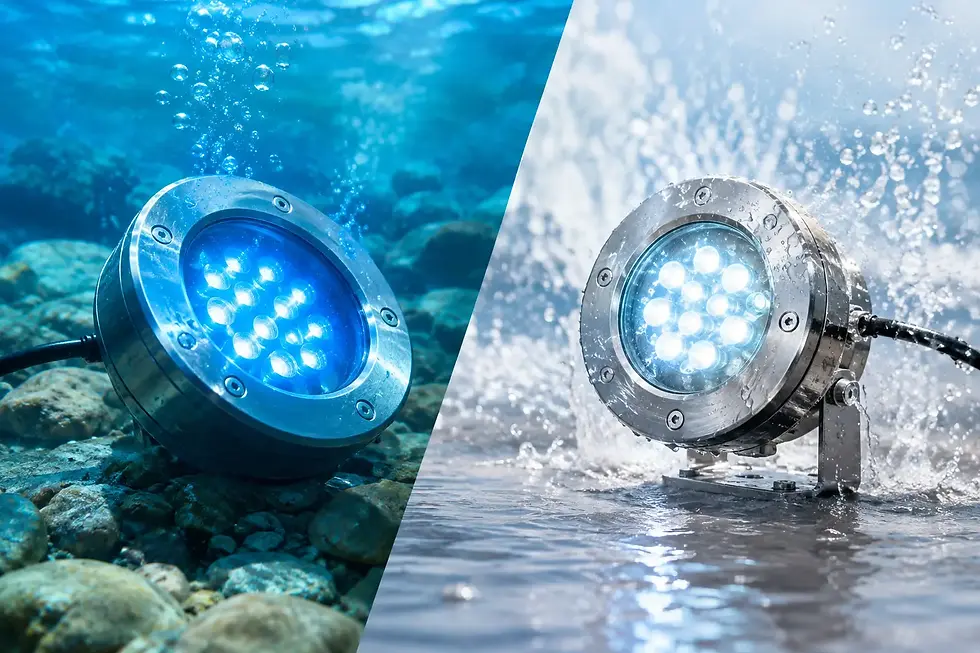
Ingress protection ratings deserve close attention. IP68 indicates protection suited to continuous immersion under conditions defined by the manufacturer, while IP69 indicates a high level of protection against high-pressure, high-temperature water jets. For underwater marine use, these ratings provide valuable confidence, but they are not a replacement for correct installation. A poor seal at the hull penetration remains a risk regardless of the light's housing rating.
AquaIDEA's Made-in-Japan underwater lighting range is designed around this need for sophisticated performance and high ingress protection in demanding marine and pool environments. For any brand, compare the stated rating, installation requirements and intended use carefully before making the final selection.
Plan for durability, service and vessel value
The most economical light is not always the lowest-priced unit. Replacing underwater fittings can involve haul-out time, labour and hull work, so construction quality matters. Look for a purpose-built marine housing, durable lens materials, stable thermal management and clearly stated underwater protection ratings.
Consider how the light will be serviced if a cable, controller or fixture needs attention. Is the cable route accessible? Can the unit be inspected without removing unrelated equipment? Will the chosen product remain available if the owner wants to add matching lights later? These questions are particularly useful for boat builders and dealers delivering a consistent, high-quality finish.
A balanced specification usually delivers the best outcome: enough output for the vessel and water conditions, a colour system that suits the owner, electrical compatibility and engineering designed for immersion. Take the time to plan the transom before the drill is picked up, and the finished lighting will look like it belongs to the boat from day one.


Comments