
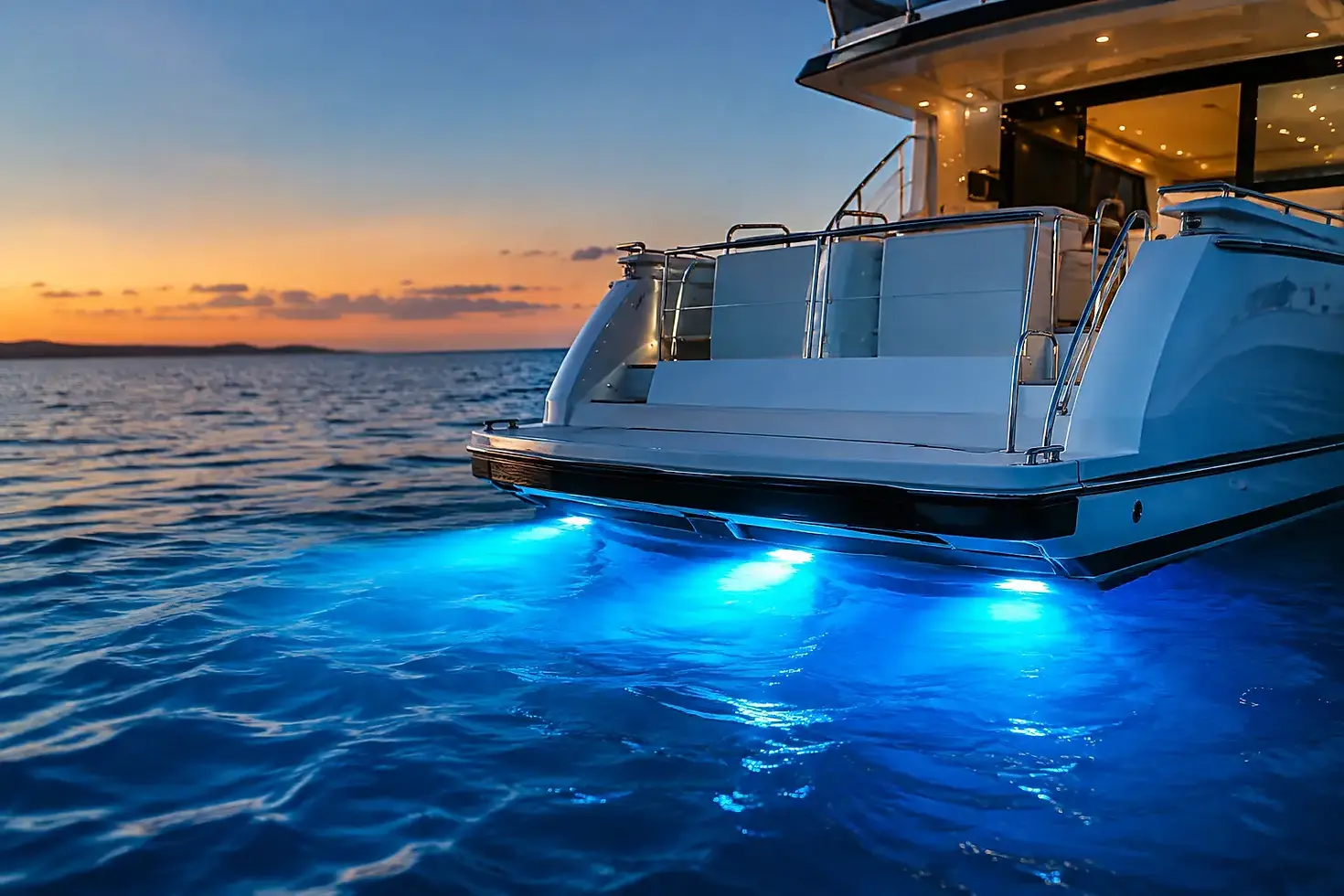
Best Voltage for Underwater Boat Lights

A transom light that looks exceptional at the berth can become a disappointing upgrade if it is matched to the wrong electrical system. The best voltage for underwater boat lights is usually the voltage your vessel already runs - most commonly 12V DC or 24V DC - but the correct choice also depends on cable length, total lighting load and the light’s stated input specification.
For Australian boat owners, builders and installers, voltage selection is not a cosmetic detail. It affects brightness consistency, installation complexity, battery demand and long-term reliability in a harsh saltwater environment. Start with the vessel’s electrical architecture, then select a premium marine light engineered to operate within it.
Best Voltage for Underwater Boat Lights: 12V or 24V?
There is no universal winner between 12V and 24V. A 12V underwater light is normally the practical choice for trailer boats, centre consoles, runabouts and many smaller cruisers because 12V DC is the standard house and starting-battery voltage on these vessels. It allows the lighting circuit to integrate naturally with existing switch panels, fuse blocks and battery banks.
A 24V system is more common on larger yachts, commercial vessels and some performance boats. When the boat is designed around 24V DC, selecting 24V-rated underwater lights avoids the need for a voltage converter. This is generally the cleaner, more dependable approach, particularly where lighting is part of a larger new-build specification.
The key rule is simple: match the light’s required voltage to the boat’s actual supply voltage. Do not assume a light will accept both 12V and 24V unless its technical documentation specifically confirms a multi-voltage input range. Connecting a 12V-only light to a 24V supply can permanently damage the electronics. A 24V-only light on a 12V circuit may not illuminate correctly, or at all.
Why 12V remains common on recreational boats
For a single pair of transom-mounted LED lights on a modest recreational vessel, 12V is often entirely suitable. Modern LED technology produces strong output with a far lower current draw than older halogen systems, allowing owners to create a refined underwater effect without placing excessive demand on the house battery.
The practical limitation is voltage drop. On a 12V circuit, even a small loss through undersized cable, poor terminals or a long cable run represents a meaningful percentage of the available supply. If voltage arriving at the light falls too far below its operating range, output can reduce, colours may appear less accurate and the driver electronics can be placed under unnecessary strain.
This does not mean 12V is inferior. It means the installation must be designed properly. Correctly sized tinned marine cable, protected circuit connections and sound routing are as important as the quality of the underwater light itself.
Where 24V has an advantage
At the same power level, a 24V lighting circuit draws approximately half the current of a 12V circuit. Lower current can reduce voltage drop over longer cable runs and may allow more efficient circuit design on larger vessels. This is particularly useful when multiple underwater lights are installed across a broad transom, along the hull, or in more complex lighting zones.
For example, a yacht with several high-output lights, long runs from the electrical distribution panel and a 24V house system is normally better served by purpose-specified 24V fixtures. The result is a more controlled installation with less dependence on converters and fewer potential points of failure.
That said, 24V does not automatically make a light brighter. Brightness is determined by the fixture’s LED design, optical system, thermal management and power rating. Voltage is the means of delivering power efficiently and safely through the vessel’s electrical system.
Calculate the whole lighting circuit, not just the light
Voltage selection should sit within a full circuit assessment. Review the number of lights, their wattage or current draw, the one-way cable distance, cable gauge, switching arrangement and protection requirements. This is especially relevant with RGB systems, which may include an integrated controller or require a compatible external control method.
A pair of compact single-colour lights may be a straightforward upgrade. A multi-light RGB installation for a large yacht is a different project, with greater attention needed for control integration, circuit loading and cable routing. Both can deliver impressive results when the electrical design matches the equipment.
Use the manufacturer’s published current draw rather than estimating from brightness or physical size. Underwater lighting is a specialised electrical load: it must perform reliably while fully submerged, often for long periods, and while exposed to vibration, salt, heat and repeated thermal cycling.
A dedicated fuse or circuit breaker should protect the lighting circuit at the power source. The rating must suit the cable capacity and expected load, not simply be increased to prevent nuisance tripping. If a fuse blows, investigate the cause before replacing it. Poor connections, water ingress in a non-marine component, damaged cable or an overloaded circuit all require correction.
Voltage drop matters more than many owners expect
Voltage drop is the reduction in voltage between the battery or distribution panel and the underwater light. It is caused by resistance in cable, terminals, joins and switches. Longer cable runs and higher current increase the effect.
On a boat, the route is rarely direct. Cable may travel from the helm or electrical locker through bulkheads and aft compartments before reaching the transom. A route that appears short from outside the vessel can become substantial once safe, concealed routing is accounted for.
Choose cable size based on the complete run and load, with an allowance for the demanding marine environment. Tinned copper marine cable is preferable to household wiring because it is designed to resist corrosion. Terminations should be correctly crimped, sealed and supported so they cannot flex or chafe. These details protect the investment in premium lighting far more effectively than adding extra wattage.
If lights dim when other onboard loads operate, or if RGB colours look inconsistent between fittings, voltage drop or a poor connection is a likely cause. A marine electrician can test voltage at the light under load and identify whether the issue sits in the supply, switching, cable run or fixture.
Avoid using a converter unless the design calls for it
A DC-DC converter can step 24V down to 12V, or in some cases support another required voltage. It can be a sensible solution where a preferred light is only offered in a voltage different from the vessel’s supply. However, it adds another electronic component, another installation location and another point that must be correctly protected from moisture, heat and mechanical damage.
For a new build or major refit, selecting lights that natively match the vessel’s system is usually the more elegant specification. For an existing vessel, a quality converter may be appropriate if it is properly rated for continuous load and installed by a qualified professional. Do not use an inexpensive automotive converter in an exposed bilge, locker or transom cavity and expect marine-grade durability.
Underwater protection is separate from voltage rating
A light can be correctly rated for 12V or 24V and still be unsuitable for permanent submersion. Voltage tells you how the product connects to the boat’s electrical system. It does not confirm water-ingress protection, housing quality, lens durability or corrosion resistance.
Look for a purpose-built underwater marine fixture with a protection rating appropriate to its installation. IP68 and IP69 ratings provide valuable technical reassurance for submerged and high-pressure washdown environments, but installation still matters. The mounting surface must be properly prepared, sealing instructions followed precisely and cable penetrations managed with care.
This is particularly relevant for flush-mounted lights, where hull preparation, bedding and cable access need to be planned before work begins. Transom-mounted lights can simplify fitment on many vessels, yet they still require a sound mounting surface and careful sealing to prevent water reaching the hull structure.
Single colour or RGB: does voltage change the decision?
The same voltage principles apply to single-colour and RGB underwater lights. Select the correct supply voltage first, then choose the lighting style that suits the vessel and how it is used.
Single-colour lighting offers a clean, consistent presentation and is often chosen for owners who want a classic blue, white or green underwater effect. RGB lighting gives greater flexibility for entertaining, marina presentation and changing the vessel’s character at the touch of a controller. The latter can involve more planning if multiple zones, synchronisation or control integration are required.
Japanese-made underwater LED lighting from AquaIDEA is designed for owners and trade professionals who want sophisticated illumination supported by marine-focused engineering. Whether the project calls for a discreet pair of transom lights or a coordinated multi-light installation, voltage compatibility should be confirmed as part of the product selection process, not after mounting has begun.
A practical specification check before ordering
Before selecting an underwater boat light, confirm the vessel’s nominal DC voltage at the distribution system and check the light’s stated operating voltage. Then consider the total number of fixtures, their combined current draw, the cable run to the stern and the planned switching or control method.
For a 12V boat, choose a 12V light or a documented multi-voltage model compatible with 12V. For a 24V vessel, choose a native 24V fitting wherever possible. Where the vessel has both 12V and 24V banks, identify exactly which bank will supply the lighting circuit rather than relying on assumptions.
A quality underwater light deserves the same discipline as any other critical marine electrical component. When voltage, cable sizing, circuit protection and submerged installation are all considered together, the finished lighting will look as refined offshore or at the marina as it does on day one.


Comments