

How to Choose Boat Lights for Australian Waters

A boat can look immaculate at the dock and still be poorly lit. The right fittings need to do more than create an impressive glow: they must support safe operation, suit the vessel’s construction and withstand saltwater, vibration and regular wash-downs. Knowing how to choose boat lights starts with separating the lights you are legally required to carry from the underwater and deck lighting that transforms the vessel after dark.
For Australian boat owners, builders and marine professionals, the best specification is rarely the brightest option on paper. It is the combination of correct purpose, suitable mounting, dependable sealing and a finish that complements the boat.
Start with the job each light must do
Boat lighting falls into two very different categories. Navigation lights communicate your vessel’s position, direction and status to other water users. Underwater lights, cockpit lighting and courtesy lights improve visibility on board and create atmosphere around the vessel. One does not replace the other.
Navigation lights should be selected and installed in line with the requirements that apply to your vessel and operating area. The required configuration can vary by vessel length, type and whether you operate inland, inshore or offshore. Check the current guidance from your state or territory maritime authority before fitting or replacing them. Pay attention to required visibility range, approved colours, placement and obstructions created by canopies, tenders, antennas or railings.
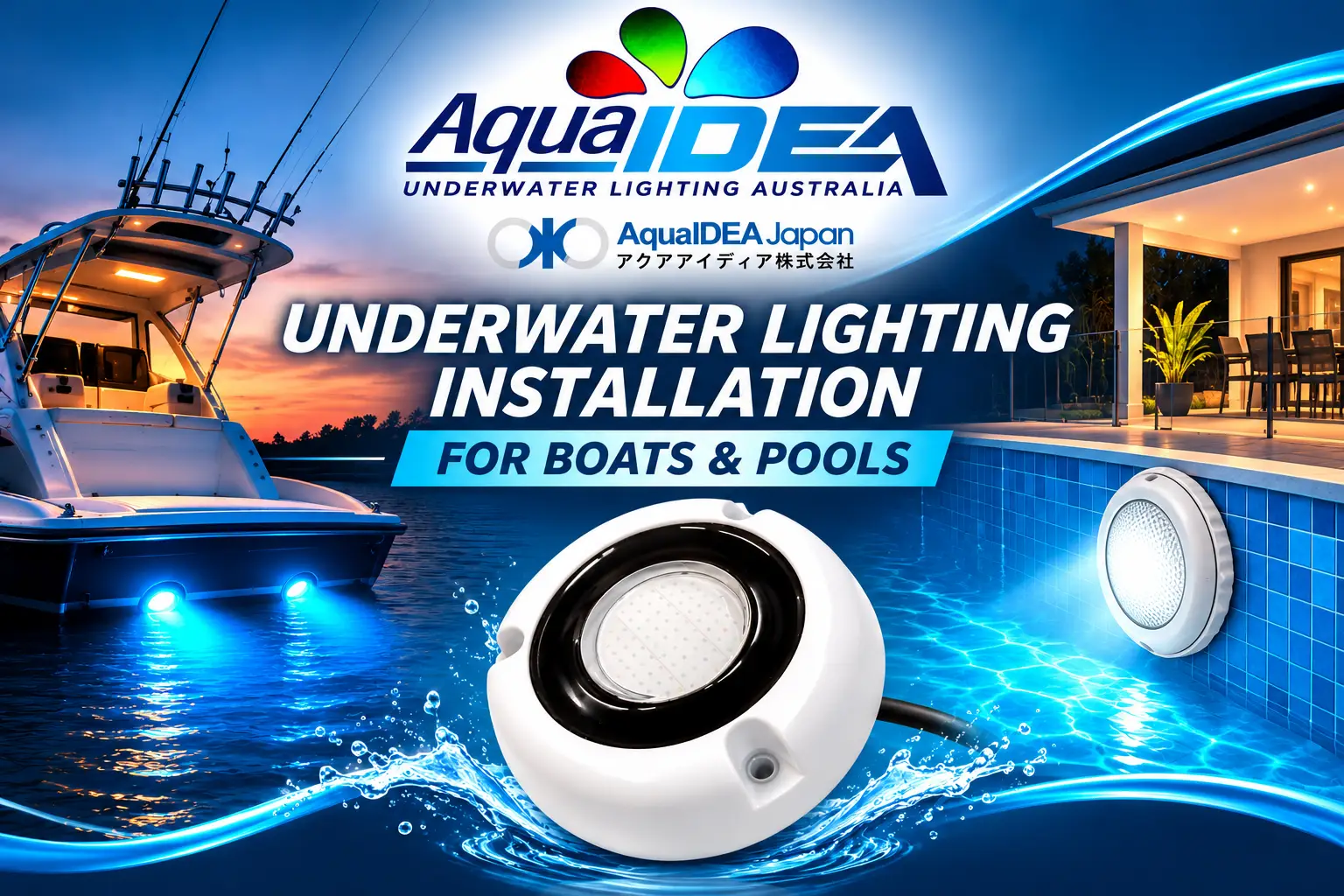
Underwater lighting is a discretionary upgrade, but it needs equally careful planning. A transom light can illuminate the water behind a cruiser for easier boarding, create a premium marina presence and make evening entertaining more inviting. On a larger yacht, multiple fixtures can provide a more even spread along the transom or hull. The aim is controlled illumination, not glare or random bright spots.
How to choose boat lights by mounting style
Mounting style determines both the appearance of the finished installation and the work required to fit it. For new builds, this decision is best made early, while cable routes, backing access and hull lay-up are still straightforward. For an existing boat, the least invasive option may be the smarter choice.
Transom-mounted lights
Transom-mounted underwater lights sit externally on the hull. They are a practical choice for many retrofits because installation generally requires a cable entry and secure fastening rather than a large hull cut-out. They also make a strong visual feature of the fitting itself.
The trade-off is that the fixture remains exposed to knocks from marina work, trailers, fenders or equipment stored near the stern. Select a compact, marine-grade housing and confirm there is a flat, structurally suitable mounting area. The light should remain below the waterline in normal use, with cable penetration and fasteners properly sealed for the hull material.
Flush-mounted lights
Flush-mounted units are recessed into the transom or hull for a cleaner, integrated finish. They suit premium new builds and owners who want minimal external hardware. With the lens sitting close to the hull surface, they can also reduce snag points and deliver a more refined appearance.
A flush installation demands more planning. The installer must verify hull thickness, internal clearance, access for wiring and the correct sealing method. On some vessels, a poor location can place a light too close to stringers, tanks, steering gear or other critical components. It is a job for an experienced marine installer, particularly where structural laminate or metalwork is involved.
Choose output for the water, not the showroom
LED output figures are useful, but they do not tell the full story underwater. Water clarity, hull position, ambient light, surface movement and the number of fixtures all affect the result. A single high-output light may give a dramatic pool of colour directly behind a small runabout, while a wider transom on a sports cruiser may need several lights spaced across the stern to avoid dark sections.
Think about where the boat spends most of its time. Clear tropical water can carry light further than a silty river, harbour or estuary. At a brightly lit marina, output needs to compete with surrounding reflections. Offshore at anchor, excessive brightness can be unpleasant for people in the cockpit and can spoil night vision.
Beam design matters as much as raw power. A broad beam provides softer coverage over a larger area; a tighter beam creates a more concentrated effect. Ask for a lighting plan based on transom width, hull form and intended use rather than choosing solely on a lumen figure.
White or RGB: match the lighting to the vessel
Single-colour white lighting is often the most timeless option. It highlights the water cleanly, works with almost every hull colour and offers a polished, understated result. Cool white can appear crisp and contemporary, while warmer tones can feel more relaxed around timber, cream upholstery and classic styling.
RGB lighting gives owners more flexibility. It can shift the mood for entertaining, match a vessel’s accent colour or create a distinctive presence at the berth. For charter, hospitality and high-end private vessels, programmable colour can be part of the on-water experience.
There is a practical consideration: RGB systems require suitable control hardware and thoughtful commissioning. Confirm how colours are selected, whether lights can be grouped into zones and how the system will be operated from the helm or a dedicated controller. If simplicity is the priority, high-quality single-colour lighting may be the better long-term choice.
Treat ingress protection as a core specification
An underwater light lives in one of the harshest environments on the vessel. It faces immersion, salt, cleaning chemicals, temperature changes, vibration and, at times, high-pressure wash-down. This is why ingress protection should be assessed before cosmetic features.
An IP68 rating indicates protection designed for continuous immersion under conditions defined by the manufacturer. IP69 adds protection against high-pressure, high-temperature water jets. These ratings are meaningful quality markers for a submerged marine fitting, but they should be read alongside the manufacturer’s installation instructions, depth limits and warranty conditions.
The rating applies to the complete light as supplied, not automatically to an installation. A poorly sealed cable entry, incorrect fastener sealant or damaged gasket can undermine an otherwise excellent fixture. Use compatible marine-grade components and avoid treating the wiring penetration as an afterthought.
Japanese-made underwater LED lights such as those supplied by AquaIDEA are designed around this demanding reality, combining sophisticated illumination with IP68-IP69 protection for long-term submerged use. Quality construction may cost more initially, but replacing failed lights or rectifying water ingress behind a transom is rarely a budget exercise.
Confirm electrical compatibility before ordering
Before choosing a light, establish the vessel’s available DC voltage and the capacity of the relevant circuit. Most recreational boats operate on 12V or 24V systems, but do not assume a fitting is compatible without checking its stated input range. Calculate total load for every light in the planned system, then allow for appropriate cable sizing, circuit protection and switching.
Voltage drop is a frequent source of disappointing LED performance, especially where the cable run from battery or distribution panel to the transom is long. Undersized cable can reduce output, affect colour consistency and create unnecessary heat. A qualified marine electrician can size the circuit based on load and run length, and ensure connections are protected from moisture and corrosion.
For RGB systems, also allow for controllers, drivers, remote receivers or integration modules. Keep control equipment in a dry, accessible location rather than burying it behind permanently fitted trim.
Plan the installation around servicing
The best-looking installation is still a poor result if basic inspection requires dismantling half the boat. Ensure the wiring route can be checked, connections can be accessed and the lights can be removed or replaced if necessary. This matters to builders handing over a new vessel as much as it does to owners upgrading an older boat.
Consider antifoul compatibility as well. Some underwater lights are designed to be maintained with approved cleaning methods or specific coatings, while others have restrictions around paint and chemical exposure. Follow the product guidance rather than applying standard hull treatments across the fitting.
After installation, test the lights in daylight and at night, both alongside and on the water. Check for even output, secure cabling, correct controller operation and any unwanted light spilling into the cockpit or onto reflective trim.
Choose boat lights as part of the vessel, not as an accessory added at the end. When mounting, electrical design, sealing and light quality are specified together, the result looks considered at the marina and remains dependable when the conditions are less forgiving.


Comments